

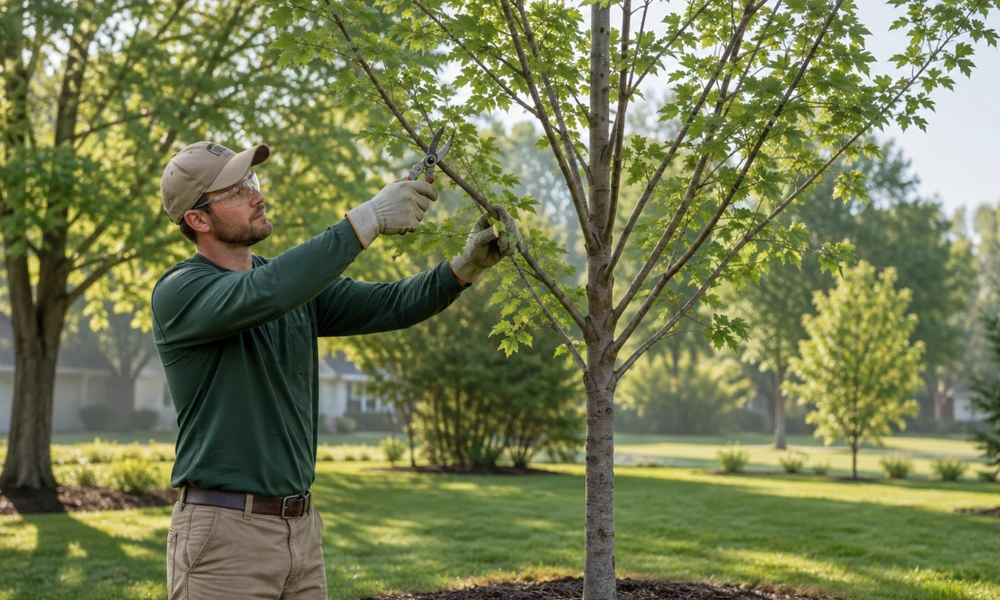
Young trees may look healthy even when their branches are beginning to develop in unsafe ways. Two stems might compete to become the main trunk. Branches may grow too close together, cross through the canopy, or connect to the trunk at weak angles.
These problems can become more serious as the tree grows. Structural tree pruning helps guide young trees toward a stronger and more balanced form. Instead of waiting for large branches to become hazardous, careful pruning addresses small problems while cuts are easier for the tree to close.
What Is Structural Tree Pruning?
Structural tree pruning is a method of training a young tree to develop a stable trunk and branch arrangement. The goal is not to create a perfectly shaped canopy. It is to encourage a structure that can better handle wind, rain, and the increasing weight of mature limbs.
Depending on the tree species, a strong structure may include one dominant central leader with well-spaced branches growing around it. Some trees naturally develop several main stems, so pruning decisions should always consider their normal growth pattern.
A young tree is inspected before any cuts are made. The person performing the work looks for competing leaders, weak branch unions, rubbing limbs, damaged growth, and branches that may eventually interfere with buildings or walkways.
Reducing Competing Leaders
A central leader is the main upright stem that continues toward the top of the tree. Sometimes, another branch grows almost as quickly and begins competing with it. This can create two similar stems with a narrow connection between them.
As the stems become larger, the union may become more likely to split during strong wind or under heavy branch weight. Structural pruning may shorten or remove the competing stem while it is still small. This allows the selected leader to become more dominant.
The correction does not always need to happen in one pruning session. Gradually reducing a competing branch can slow its growth while allowing the tree to keep enough leaves for energy production.
Creating Better Branch Spacing
Branches growing from nearly the same location can place extra stress on one area of the trunk. Closely spaced limbs may also rub against one another as they move in the wind.
Structural tree pruning encourages more space between permanent branches. Well-spaced limbs have more room to grow and may form stronger attachments to the trunk. Temporary branches can sometimes remain on a young tree for a while because they help support trunk growth and protect the bark from excessive sunlight.
The key is deciding which branches should become part of the mature canopy and which ones should eventually be removed.
Why Early Pruning Can Prevent Larger Problems
Removing a small branch from a young tree usually creates a much smaller wound than removing the same branch years later. Early correction can also reduce the need for heavy pruning after the tree reaches mature size.
Without early care, a weak branch may grow over a roof, driveway, street, or play area. Removing it later may require climbing equipment and create a large wound in the trunk.
Proper structural pruning can help:
- Develop a strong main trunk
- Improve spacing between permanent limbs
- Reduce weak or crowded branch unions
- Prevent rubbing and crossing branches
- Provide clearance from nearby structures
- Lower the chance of large branch failure
- Reduce future corrective pruning needs
Avoid Removing Too Much at Once
Young trees need leaves to produce energy and develop healthy roots. Removing too much of the canopy can slow growth and place unnecessary stress on the tree.
Topping should never be used as a form of structural pruning. Cutting back the upper canopy without considering branch structure can create weak sprouts and lasting damage. Cuts should also be made near the branch collar without cutting into the trunk or leaving a long stub.
Pruning needs vary by species, condition, climate, and time of year. Larger corrections or uncertain branch structures should be evaluated by a qualified tree-care professional.
Building Strength Over Time
Structural tree pruning is usually a process rather than a one-time task. A young tree may need to be inspected every few years as its canopy develops. Small adjustments made over time can guide its growth without causing sudden stress.
Starting early gives a tree a better chance to develop strong branches, useful clearance, and a stable form. The work may seem minor at first, but those careful cuts can help the tree grow more safely for many years.
This post was written by a professional arborist at Arborist Clearwater FL. Robert Miller is the owner of Arbor Wise Professional Tree Care, a locally owned and operated tree service company that offers superb lawn care by the most experienced Arborists. Arborwise Tree Services is a tree removal company that offers stump removal, tree pruning, stump grinding, fertilization, and tree restoration. We have an extraordinary lawn care industry notoriety covering the Pinellas county area.
