

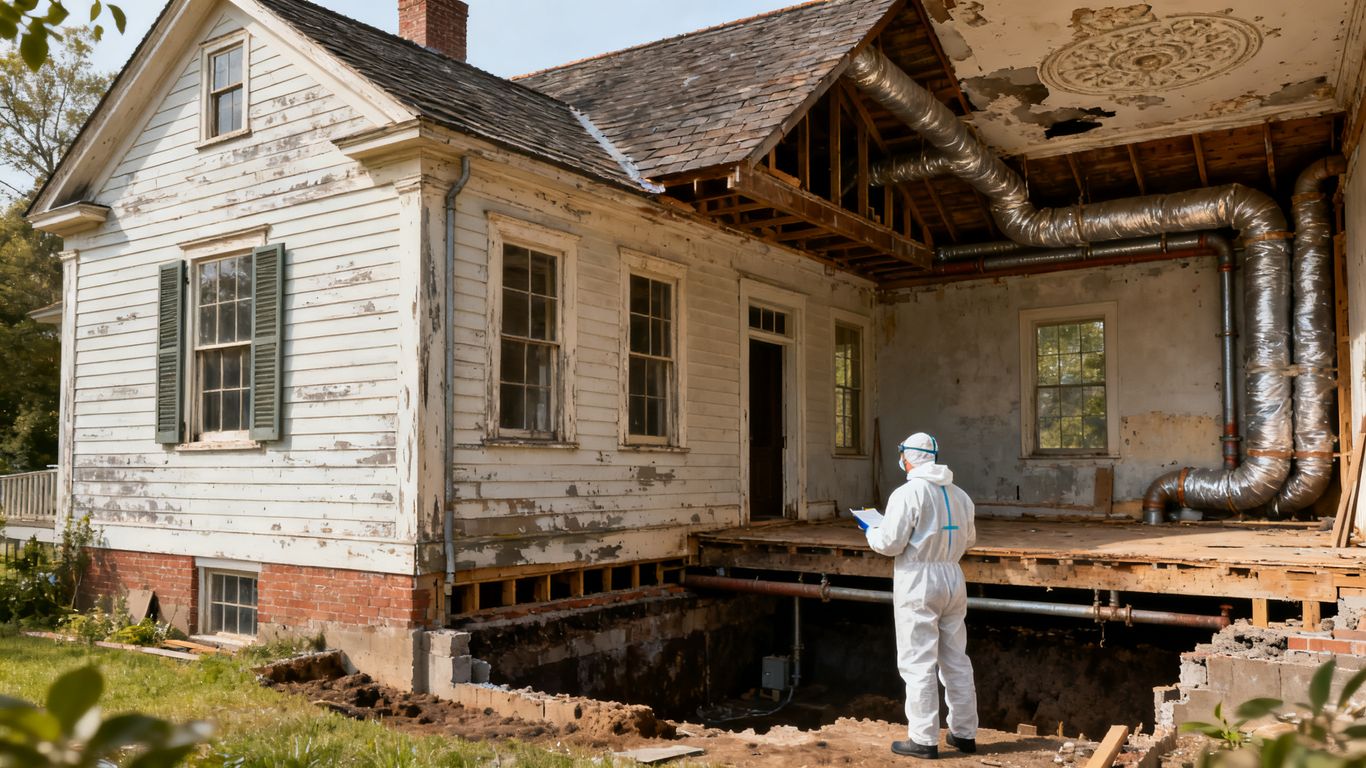
Buying an older property often means accepting layers of construction history that are not visible at first glance. Materials installed decades ago may remain beneath newer finishes, even after several rounds of painting, remodeling, and repair. For that reason, asbestos in historic homes deserves a methodical review before a buyer commits to the purchase.
How age and renovation history affect asbestos risk
A home’s construction date is an important starting point, but it is not the only clue. Asbestos-containing products were used widely through much of the twentieth century, and some materials could remain in circulation after restrictions began. A house built or renovated from the 1930s through the 1970s may therefore warrant particular care, while an 1980s property can still contain older products or materials installed during an earlier renovation.
Renovation history adds another layer of uncertainty. A permit may show that a kitchen was updated, but it may not reveal whether older floor adhesive, pipe insulation, or wall compound was removed. Conversely, an apparently untouched area may have been covered rather than replaced. The safest assumption is that age and records help identify risk; they do not confirm or rule out asbestos.
Why asbestos may be present even when a home looks well maintained
Fresh paint, replacement flooring, and carefully restored woodwork can make a historic home appear entirely modern. Those improvements may conceal original materials instead of eliminating them. A smooth surface can sit over an older textured coating, and new flooring can cover adhesive that was never disturbed.
Good maintenance can reduce the likelihood that a material is crumbling or damaged, but it does not change its composition. A well-kept mechanical room may still contain aging insulation around a boiler, just as a beautifully finished room may retain older ceiling texture. Buyers should treat visual condition and asbestos status as two separate questions.
Common construction periods and materials associated with asbestos
Asbestos was valued for properties such as fire resistance, durability, and insulation. It could be incorporated into cement products, floor tiles, insulation, roofing, siding, ceiling finishes, and compounds used during construction. The material was not limited to one room or one type of building.
The most useful initial exercise is to create a map of likely materials rather than searching for one telltale appearance. A practical older-home asbestos overview can help a buyer organize that review by construction period and common locations. It should be treated as background information, not a substitute for professional sampling.
Why visual inspection alone cannot confirm asbestos
Asbestos fibers are microscopic, and the appearance of a suspect product can overlap with many non-asbestos materials. Color, age, texture, and wear may raise a reasonable question, but none can provide a dependable identification. Even an experienced buyer should avoid scraping, breaking, or lifting a material to get a closer look.
Laboratory analysis of an appropriate sample is generally needed to confirm presence. Until testing is completed, a suspect material should be left undisturbed and its condition recorded from a safe distance. Visual clues are only screening clues, not a final answer.
Where asbestos may be found in a historic home
Asbestos risks can be distributed across a property, including in spaces buyers rarely inspect closely during a showing. Some materials are obvious once attention is directed toward them, while others are hidden behind finishes or inside service areas. A room-by-room inventory gives the buyer and inspector a more useful starting point than a general impression of the house.
Insulation around pipes, boilers, and heating systems
Older heating systems may have insulation wrapped around pipes, boilers, ducts, tanks, or fittings. This insulation can appear as a fabric-like covering, a molded section, or a sprayed or layered coating. Mechanical rooms and basements deserve special attention because repairs, moisture, vibration, and repeated servicing can damage these materials.
The condition matters as much as the location. Cracking, flaking, water damage, or loose sections should be documented without touching them. A buyer should keep contractors and household members away from questionable insulation until a qualified professional determines what it is and how it should be managed.
Flooring, adhesives, and ceiling materials
Older resilient floor tiles, sheet flooring, backing materials, and dark adhesives are among the materials that may require investigation. Ceiling texture and acoustic coatings can also be suspect, particularly where a future renovation would involve scraping, sanding, drilling, or removal. Layers of flooring make the question more complicated because the visible surface may not be the oldest one.
A buyer considering a kitchen, bath, or basement renovation should identify every layer that the project could disturb. Guidance on common asbestos locations can help focus attention on flooring, ceiling finishes, insulation, and related building components. No suspected material should be pulled up simply to see what lies beneath it.
Roofing, siding, windows, and exterior components
Exterior products may include cement siding, roofing materials, flashing, gutters, caulks, or components associated with older windows. Their outdoor location does not make them irrelevant: replacement work can create dust, fragments, and disposal concerns, especially around occupied porches, garages, and additions.
Weathering can make an older exterior material brittle, but age alone does not establish that it contains asbestos. The inspection should consider the planned work, the material’s condition, and whether local rules apply to removal or disposal. A specialist can advise whether sampling is appropriate before a buyer schedules exterior repairs.
Plaster, drywall compounds, and other renovation materials
Asbestos may also occur in plaster, joint compounds, textured paints, patching products, and materials used to finish or repair walls and ceilings. These products are easy to overlook because they form a thin surface layer rather than a large, recognizable component. Small repairs made over many years can create several areas with different materials.
This is particularly relevant when a buyer hopes to open walls, relocate doors, install recessed lighting, or repair historic plaster. The question is not only whether the original wall is suspect, but also whether later compounds and coatings could be disturbed. A written renovation plan helps an inspector choose areas that deserve closer assessment.
How to investigate asbestos before buying
The best time to investigate suspected asbestos is before the inspection and financing contingencies expire. Buyers need enough information to understand the likely scope of work, obtain realistic estimates, and decide whether the property still fits their plans. Investigation should be deliberate rather than driven by an impulse to test every visible surface.
Reviewing permits, renovation records, and seller disclosures
Permit files, contractor invoices, prior inspection reports, and seller disclosures can reveal when materials were added, covered, or removed. They may also identify unfinished work or previous concerns in a boiler room, attic, or basement. A gap in the records is not proof that asbestos exists, but it should prevent a buyer from assuming that an area is clear.
The buyer should ask specific questions about flooring replacement, ceiling removal, heating upgrades, insulation work, and demolition. Records should be compared with the current condition of the house because undocumented work is common in older properties. Any answer that is vague or incomplete can be carried forward as an item for professional review.
Hiring a qualified asbestos inspector
A qualified asbestos inspector can examine accessible areas, assess the condition of suspect materials, and collect samples using appropriate procedures. The inspector’s role is different from that of a general home inspector: the asbestos professional is focused on identifying and evaluating potential asbestos-containing materials. The buyer should verify applicable credentials, insurance, and independence before hiring.
A useful professional testing guide reinforces the central safety step: suspected material should not be disturbed while a buyer is deciding what to do. The inspector’s written report should identify sampled locations, laboratory results, limitations, and recommendations. That detail gives the buyer something concrete to share with an abatement specialist or renovation contractor.
Choosing materials for laboratory testing
Testing should be based on the home’s age, planned work, and the locations where disturbance is most likely. Sampling every material may be unnecessary, while testing only the most obvious material can leave important gaps. The inspector should explain why each sample was selected and whether multiple layers or visually different areas need separate analysis.
A practical sequence may include:
- Suspect insulation near boilers, pipes, ducts, and tanks
- Flooring, backing, and adhesive in rooms planned for renovation
- Textured ceilings, plaster, joint compounds, and patching materials
- Exterior siding, roofing, window-related materials, or cement products affected by planned work
The resulting laboratory report is most useful when it is read alongside the renovation scope. A negative result for one sample does not automatically clear every similar-looking material elsewhere in the home. Buyers should ask the inspector to identify untested assumptions before relying on the report in negotiations.
Understanding the limits of a standard home inspection
A standard home inspection can identify visible defects and may call attention to materials that appear unusual or deteriorated. It generally does not provide a definitive asbestos determination, and its inspection methods may not include invasive sampling. A buyer who assumes the general report covers asbestos could make decisions on incomplete information.
The inspection report should therefore be used as a referral point rather than a clearance certificate. If it mentions older insulation, textured ceilings, suspect floor materials, or inaccessible areas, those observations can guide a separate asbestos evaluation. The distinction is especially important when the buyer’s plans involve demolition or substantial remodeling.
Health risks and conditions that can disturb asbestos
The primary concern is not simply that an older material exists, but that asbestos fibers may become airborne and be inhaled. Exposure can occur when a material is damaged, deteriorated, or disturbed without suitable controls. Buyers should understand that risk varies by condition and activity, while avoiding the assumption that a material is safe merely because it is currently out of sight.
Why intact asbestos-containing materials may pose less immediate risk
A confirmed asbestos-containing material that is intact, sealed, and left alone may pose less immediate risk than one that is crumbling or actively being worked on. That distinction often informs whether the material is managed in place or addressed through professional abatement. Lower immediate risk does not make the material harmless or eliminate the need for a future plan.
Condition can change with water intrusion, vibration, impact, age, or building work. Even a material that looks stable should be monitored according to professional advice. Buyers should record its location and make sure future contractors know about it before beginning repairs.
How remodeling, repairs, and demolition can release fibers
Drilling, sanding, scraping, cutting, pulling up flooring, removing walls, or dismantling insulation can disturb asbestos-containing materials. Dust from a small repair can migrate beyond the immediate work area, which is why ordinary household cleanup is not an adequate substitute for controlled procedures. Demolition and major renovations require planning before any surface is opened.
The risk is also present during routine maintenance. A plumber, electrician, roofer, or heating technician may encounter suspect materials while performing work that was not originally expected to involve asbestos. The safest course is to pause the task and obtain specialist direction rather than allowing a contractor to proceed on an assumption.
Higher-risk areas such as attics, basements, and mechanical rooms
Attics, basements, crawl spaces, and mechanical rooms often contain concentrated building services and older insulation. They may also have limited ventilation, tight access, or evidence of past repairs. A buyer should not enter a dusty or confined area merely to collect a sample or investigate a suspicious texture.
Attic fill, pipe wrapping, boiler insulation, duct coverings, and old electrical or heating penetrations all merit attention when the property is of an appropriate age. A guide to asbestos risks offers additional context for these common locations and for the importance of laboratory confirmation. Professional access is preferable when inspection would require disturbing insulation or entering a difficult space.
Health effects associated with asbestos exposure
Inhaled asbestos fibers can contribute to serious diseases, including asbestosis, lung cancer, and mesothelioma. These conditions may develop after a long latency period, so a person cannot judge the significance of exposure by how they feel immediately afterward. There is no known safe level of asbestos exposure, making prevention and controlled handling the central priorities.
This information is not a diagnosis or a personal medical assessment. Anyone concerned about past exposure should discuss that concern with a qualified healthcare professional. For the property decision, the practical response is to prevent additional exposure and obtain advice from appropriately qualified asbestos professionals.
What asbestos findings mean for the purchase decision
An asbestos finding does not automatically make a historic home unbuyable. Its significance depends on the material, condition, location, quantity, planned renovations, and likely cost of professional work. The buyer’s objective is to replace uncertainty with a documented scope and a decision that remains financially and practically comfortable.
Estimating testing, abatement, and disposal costs
A laboratory fee is only one part of the potential expense. Costs may include additional inspection, containment, removal or encapsulation, air monitoring, disposal, surface replacement, repairs, and temporary relocation. Estimates should be based on the actual materials and quantities rather than on a generic allowance.
The buyer should request written proposals that describe the work boundaries and assumptions. It is also sensible to ask whether the estimate includes preparation, cleanup, transportation, disposal, and required testing after the work. Clear scope prevents an apparently modest estimate from becoming an incomplete budget.
Comparing management in place with professional removal
Removal is not always the only appropriate response. Depending on the material’s condition and location, a professional may recommend leaving it in place with controls, sealing or encapsulation, restricted access, and future monitoring. Removal may be more suitable when a renovation would otherwise disturb the material or when deterioration makes continued management unreliable.
The choice should be made by a qualified asbestos professional, not by a buyer trying to reduce the purchase price. Management in place also requires household discipline: records should be retained, future contractors informed, and the material protected from accidental damage. A lower immediate cost can be reasonable only when the long-term obligations are understood.
Negotiating repairs, credits, or contingencies with the seller
Once testing and estimates are available, the buyer can discuss a repair, a closing credit, a price adjustment, or an extended contingency. The agreement should specify who selects the contractor, what documentation must be provided, and whether post-work inspection or clearance testing is required. A vague promise to “take care of the asbestos” leaves too much unresolved.
Negotiations should also account for timing. If work cannot be completed before closing, the contract may need funds held in escrow, a defined completion deadline, or a right to cancel if the scope changes materially. The buyer’s attorney and real estate professionals can help translate the technical report into enforceable terms.
When asbestos discoveries may justify walking away
Walking away can be reasonable when the cost is uncertain, the required work conflicts with preservation goals, or the buyer cannot safely finance and manage the renovation. It may also be the prudent choice when the seller will not allow adequate testing or refuses a workable contractual solution. The decision is personal, but it should be based on documented risk rather than fear or wishful thinking.
A buyer should consider whether the property remains affordable after professional work, whether temporary relocation is possible, and whether future remodeling plans are realistic. If the answers are unfavorable, declining the purchase may be more responsible than accepting a problem without a credible plan.
Legal, regulatory, and renovation considerations
Asbestos work is governed by rules that can differ according to the material, project size, building type, and jurisdiction. Historic properties may also carry preservation obligations that affect how original surfaces are repaired or replaced. Buyers should confirm the applicable requirements early, before signing a renovation contract or setting a closing schedule.
Federal, state, and local requirements for asbestos work
Federal requirements may interact with state and local licensing, notification, work-practice, transportation, and disposal rules. Requirements can vary substantially, so a buyer should not rely on an internet checklist or assume that a contractor’s ordinary license covers asbestos activities. The responsible professional should explain which rules apply to the specific project.
The buyer should request copies of licenses, notifications, waste records, and final documentation where applicable. Written confirmation is especially useful when a project involves demolition, extensive removal, or a multifamily or commercial component. Local environmental or building authorities can clarify requirements that are not addressed in a seller’s records.
Historic preservation rules that may affect removal or replacement
A property listed on a historic register or protected by a local preservation ordinance may have restrictions on exterior siding, windows, roofing, trim, and other visible features. Removing an asbestos-containing component may therefore require approval for both the abatement method and the replacement material. Preservation concerns do not override health and safety requirements, but they can affect design and scheduling.
The buyer should determine the property’s designation before promising a particular renovation. Preservation staff, an architect familiar with historic buildings, and an asbestos professional may need to coordinate. That collaboration can help retain significant character while ensuring that hazardous materials are not disturbed improperly.
Selecting licensed asbestos professionals and contractors
The buyer should select professionals with credentials appropriate to the jurisdiction and project, demonstrated asbestos experience, current insurance, and a clear written scope. The inspection, laboratory analysis, abatement, and reconstruction phases may involve different specialists. Independence is valuable when the person recommending work is not paid solely according to the amount removed.
References and documentation matter more than a low preliminary price. A responsible contractor should explain containment, worker protection, disposal, cleanup, and any required clearance process in language the buyer can understand. The buyer should be cautious of anyone who claims to identify asbestos reliably by sight or encourages do-it-yourself removal.
Planning safe renovations after closing on the home
Renovation planning should begin with the asbestos report, not with demolition day. The buyer should give contractors a written record of confirmed and presumed materials, mark no-work areas, and require a pause if an unexpected suspect material is uncovered. Utility work and small repairs deserve the same caution as a large remodel because they can affect hidden layers.
A sensible project sequence allows asbestos decisions to be made before other trades arrive. For broader background on locations and precautions, a practical asbestos safety guide can help a new owner frame questions for qualified professionals. With records, appropriate testing, and a carefully defined scope, a historic home can be evaluated as an old building with manageable obligations rather than as an unknowable hazard.
